BLOG

July 22, 2026

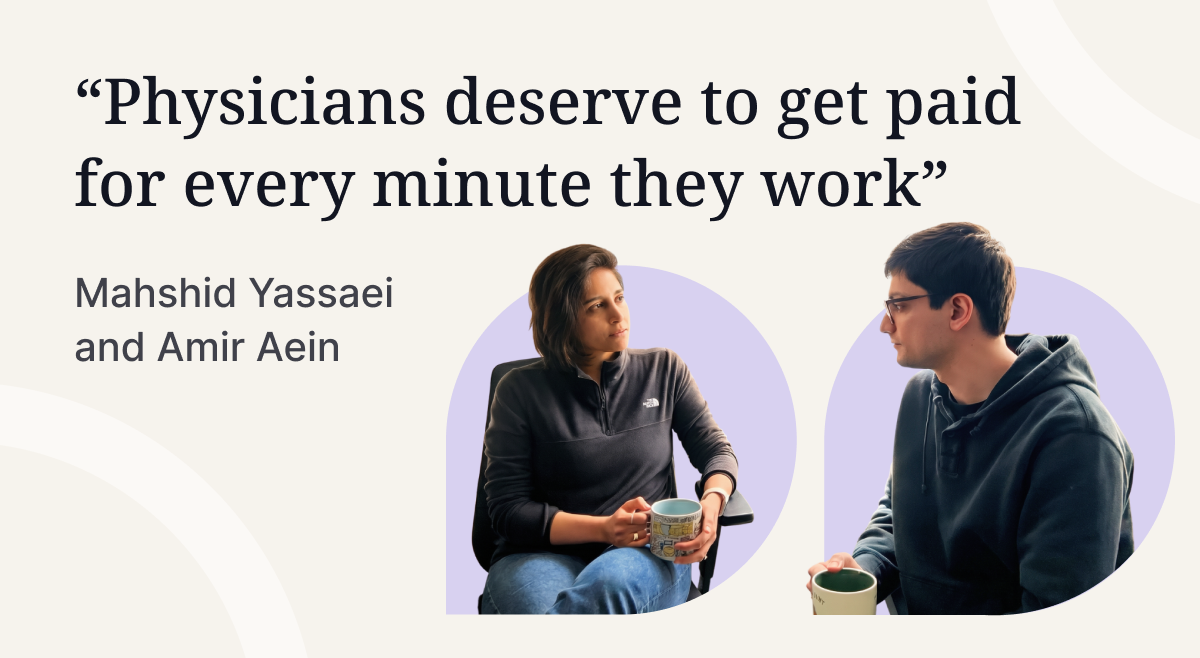
Mahshid Yassaei, co-founder and CEO of Tali AI, sits down with Amir Aein, the Product Manager leading Tali's billing agent.
I've been wanting to have this conversation publicly for a while. Billing is one of those problems that every physician mentions within the first five minutes of any conversation, and yet it's been sitting there, largely unsolved, for decades. When we started building toward it at Tali, I knew it would be a company-defining move. Amir has been leading that charge, and I think it's time people heard the story directly from him.
Mahshid: Amir, for people who don't know you, and honestly, they probably know your work without realizing it. Can you introduce yourself and what you've been building?
Amir: Of course! My name is Amir Aein. I've been with Tali for close to five years. I started as a product designer, I had over ten years of design experience before joining, and moved into product management about two years ago. For the past year, I've been leading the team focused on billing within the clinical workflow. I'm really excited that we have something reliable and genuinely useful out in the market now, something clinicians are actually using to save time and increase their revenue.
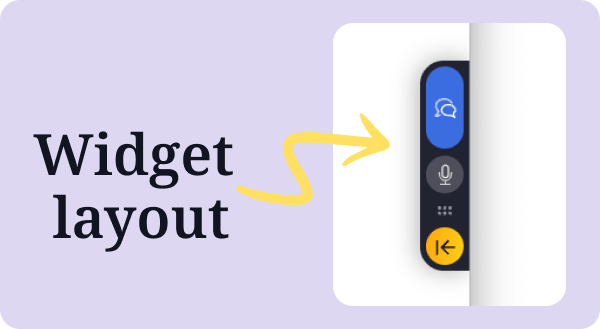
Mahshid: I'll add a small plug here, a lot of the interaction patterns that you see in AI scribe products today, including that widget layout that so many companies have copied, that came from Amir. So this is someone who's been shaping how physicians interact with AI for years. And now he's taken on what I think is an even bigger challenge. Amir, when you were talking to physicians, what kept coming up around billing that made it clear this was the right next problem to solve?
Amir: You know there's a tell when you're onto something real, people don't just have one complaint, they have a list, and they already know exactly what's on it. That's what happened with billing. The moment you brought it up, conversations would immediately turn into four or five categories of pain, almost like physicians had been waiting for someone to ask. That shared frustration, across so many different people and practice types, was the biggest signal that this wasn't a niche problem. It's a whole product line, almost a company of its own. And it can even stand independently from AI Scribe. They have great synergy, but a physician doesn't need one to get value from the other.
Mahshid: And that's actually what made it a hard internal conversation too, right? Because billing software isn't new. There are systems out there. So when we were thinking about this, the obvious question was, why would an agentic AI approach be any different from what already exists?
Amir: Right, and that's exactly the right question. The legacy systems weren't lacking automation, at least on paper. You had access to all these capabilities, imagine a form with a thousand fields that, if filled out perfectly, handles everything. The problem was never the API connection between a clinic and OHIP. The problem was everything that has to happen before you even get there.
Take Ontario as an example. The Schedule of Benefits, the document that specifies what you can claim, is over a thousand pages long. For a family physician alone, that's more than 100 pages of dense tables in tiny font. Nobody has time to read all of that. Nobody can keep up with the quarterly updates. And that's not even the only source of truth, there are OMA documents, bulletins, and more, all layered on top.
So what ends up happening is that physicians default to the same five or ten codes for every visit, regardless of the complexity of the case or the time they put in. Higher billing codes exist for more complicated cases because those cases demand more expertise and time. Physicians are delivering that, they're just not getting paid for it.
Physicians Deserve to Get Paid for Every Minute They Work
Mahshid: So the agentic part isn't about connecting to a system, it's about doing the thinking that no one has time to do.
Amir: Exactly. And once we framed it that way, the north star became pretty clear. The agent should never make decisions on behalf of clinicians without their confirmation, not clinical decisions, not even billing decisions. Those are tied directly to their revenue stream, and they need to stay in control. That was a non-negotiable from day one. On the positive side, the goal was to create something that delivers real monetary value: surfacing under-billed visits, reducing rejections, and even proactively flagging when a patient is eligible for a service. Something as simple as reminding a physician that a patient is due for their annual physical, that benefits the patient and means the provider gets properly reimbursed for the visit.
Mahshid: I remember the early conversations about scope, because there was a lot of excitement, and a lot of pressure, to go broad fast. What were the tough calls you had to make?
Amir: The hardest one was not jumping into other provinces right away. We were hearing demand from BC, Alberta, Quebec almost immediately, the concept excited people everywhere. But our decision was to nail it at home in Ontario first. Get the accuracy to Tali's standards, prove the value to clinicians here, then expand. There's no shortcut to trust.
Mahshid: Can you give us any hint on what's coming next?
Amir: I can say that BC, Alberta, and Quebec are the top three, in line with where we've seen the highest demand.
Mahshid: I also want to talk about the internal journey, because this wasn't a small team quietly shipping a feature. There was a real company-wide alignment that had to happen. Who were the people that made this possible?
Amir: Internally, our CTPO Hesam Dadafarin was the driving force. He had been advocating for this problem space for months before we formally kicked off. He saw how closely billing tied into what AI scribe already provided and recognized it as something with real impact. The prioritization conversations across the company were tough, building the billing agent meant not spending resources on a lot of other things teams wanted to build. Those trade-offs were hard, but I'm glad the company stayed the course.
Externally, our Clinical Advisory Group was with us from day one. One advisor in particular had been asking, informally, whether Tali would ever go into billing months before we even started. We'd be in a session about something completely different, templates, smart edits, and at the end he'd say, "Do you think you'll ever go into billing?" It came completely organically from him. He ended up being one of our closest allies throughout the project, and that meant a great deal to the whole team.
Mahshid: Okay, let's get into the product itself. Walk me through it like I'm a physician who just raised their hand and said I'm interested, what happens?
Amir: So the first step is going into your OHIP portal, a system called MCEDT, and designating Tali as your billing agent. That gives us the authorization we need. We spent several months working with the Ministry of Health of Ontario to pass their conformance testing and become an officially approved biller. We didn't want to move sensitive financial and patient information through any back channel, going through the ministry was the only right way.
Once that's set up, we retrieve your patient billing history and load it into Tali. From there, you use Tali pretty much as normal, with a few additions. You specify the modality of your visit, in-office, home visit, phone call, because that affects billing. You select the patient from your pre-loaded list. You start the encounter.
When the encounter ends and you're reviewing your note, Tali recommends accurate diagnostic and billing codes. And what makes those recommendations meaningful is that we're not just doing keyword matching. We're cross-referencing the patient's full billing history to make sure every eligibility criterion is met.
A concrete example: smoking cessation. The easy approach would be to detect the topic and suggest a code. But a savvy biller knows that the initial code can only be claimed once every 12 months, and only two follow-up codes are allowed within that window. Tali does all of that cross-referencing automatically. If we recommend a smoking cessation follow-up, you can trust that we've already checked the patient's history. You don't have to do it yourself while managing 40 other patients.
After that, you can submit the claim directly from Tali, or keep using your existing EMR or third-party billing software, whatever you prefer. Nothing is forced. And nothing happens automatically, you review the recommendations, approve them, and you stay in control the whole time.
Finally, every month OHIP produces a reconciliation report. It's a machine-generated document, essentially unreadable by humans. Most clinicians either ignore it or rely on a third-party tool that spits out a static PDF. Tali turns that into an interactive dashboard where you can track every claim: was it paid, adjusted, or rejected? If it was rejected, you can see why, and what the recommended next steps are. The goal is to close the loop, from the first thought of "what should I bill?" all the way through to actual payment.
Mahshid: And all of this is pulling from MCEDT, which raises a question I know clinicians ask all the time, is any of their information being shared back to the government through Tali?
Amir: No. The extent of our integration with OHIP is to read a patient's billing history and to submit claims on the clinician's behalf. That's it. Information only flows in the direction the clinician authorizes. And I'll add, Tali was already operating at the highest standard of security and privacy before we ever touched billing. We've gone through HIPAA, been approved by major EMRs, Canada Health Infoway, Doctors of BC, the Supply Ontario, each with their own rigorous conformance process. Expanding that framework to billing was actually quite natural. The foundation was already there.
Mahshid: Let's talk about what you heard back from clinicians. What were the early signals that told you this was going in the right direction?
Amir: The most telling signal was watching how the conversations changed over time. Early on, when we showed the first version of the recommender engine, physicians had a lot of questions, all useful, about how it worked and whether it fit their workflow. As we built out more of the end-to-end cycle, the questions started to shrink and the feedback turned into something else: excitement. Pure excitement. They could immediately see how it applied to problems they deal with every single day.
It reminded me of those early AI scribe demos, that moment where a physician realizes they don't have to manually type their notes anymore and you can just see the weight lift off their shoulders. That look. That's the signal.
Mahshid: Were there any surprises along the way, reactions or use cases you didn't expect?
Amir: Two things stand out. The first: out of everyone I've spoken to, exactly one person told me their billing workflow was working perfectly fine. What surprised me wasn't the answer, it was that there was only one. Usually you find clusters of people who are managing well. Here, it was one person out of dozens and dozens.
The second thing still surprises me every time I hear it, and unfortunately I hear it often: when a claim gets rejected, many clinicians just move on. They say, "I'll go see the next patient." If you poured someone a cup of tea and they walked out without paying, you wouldn't shrug and say "next customer." But that's essentially what's happening. Physicians spend their time, bring their expertise, and because chasing a $25 rejection feels too painful, they let it go.
I empathize with it, I understand why it happens. But it still shocks me that this has gone unsolved for so long. And even in the best-case scenario, a clinic with a dedicated billing specialist, when I ask physicians how they know every rejection is being actioned, they say they just trust that person and hope for the best. There's so much room for human error there.
Mahshid: Okay, last two questions. Where does the billing agent go from here?
Amir: The big picture is that billing should never feel like a problem. Physicians should actually feel good about it, excited about being properly compensated for everything they do. The roadmap is about covering the full billing cycle in one agentic platform that doesn't wait to be asked. It proactively takes action, and the physician gets the joy of passive supervision rather than active management.
Mahshid: And what's one thing you wish you'd known at the start of this project?
Amir: How many people a billing process actually touches. When we started, we were naturally focused on the clinician; they're the one getting paid, after all. But the more we dug in, the more we realized that everyone in a clinic feels the inefficiency of billing in some form. The person booking appointments, the clinic manager, the owner of a multi-provider practice, they're all affected. Solving this end-to-end doesn't just change the clinician's day. It changes everyone's day.
Mahshid: That's a beautiful way to put it. Thank you, Amir, I'm really proud of what the team has built, and I can't wait for more clinicians to experience it.
Physicians spend years training to do work that matters. They deserve a system that makes sure that work is recognized, documented, and paid for. That's what this team built. And we're just getting started.
If you're in Ontario and want to be among the first to use Tali Billing, join the waitlist for priority access.
Mahshid Yassaei Co-founder and CEO, Tali AI
Experience the future of healthcare documentation with Tali's AI-powered solutions.
Start Free TrialRelated Articles


Tali AI
September 16, 2022

Tali AI
October 17, 2022

Research
July 22, 2026
8
Research
July 22, 2026
8
Research
July 22, 2026
8